www.innovationgame.com/physics/kuijk/particle.htm April 2002
General solution of the complex time-dependent wave equations for particle and antiparticle
W.Kuijk-Grünbauer
UCA-UA, Department of Science, Groenenborgerlaan 171, 2020 Antwerpen, Belgium
PACS Numbers: 03.65.-w, 03.65.Bz, 03.65.Ge, 03.65.Fd, 02.50.Wg, 05.60.Gg
|
This paper is published on the World Wide Web under the strict condition
that it is the author's copyright. Any use, or copying, of any part of its
contents, or the author's original ideas, is allowed only on condition that
it is acknowledged by citation to be the work of the original author.
|
Abstract
In this paper we employ S. Madelung's method (1926, [1]), to solve
in full generality, what were, before and around 1926, considered to be the two
(one-dimensional, complex conjugate) "hydrodynamic mass flow equations"  where the signs are referred to as 'signatures'. We show the use of these solutions in problems of the electrodynamics of the H-atom vs. the anti-H-atom. For instance: it is said that the sign change of all the quantum numbers (n,l,ml) of the hydrogenic electron turns it into the positron of the anti-H-atom. It is shown that one needs on top of these sign changes a parity change of the coordinates, but that one can get the positron also by replacing the mass me of the electron in all the formulas describing it, by its opposite -me. Instead of the principle of C(harge), P(arity), T(ime) inversion in quantum mechanics we propose M(ass), P(arity), T(ime) inversion.
Pre-amble
The equations CWE(±) are in one space coordinate x and time t only, with A  0 any real constant and C a real function that is not necessarily independent of x and t. Since the general entire solutions of these equations may be written in the form Ψ(±) = exp(R(x,t) ± iS(x,t)), with R(x,t) and S(x,t) real functions of A and C, and since these solutions turn out to be well-determined complex wave functions afterwards, we call CWE(±) the "complex time-dependent wave equations" in the title. Obviously, CWE(±) contains the well-known "second" or "time-dependent" Schrödinger equation for special values of A and C. However, the general solutions Ψ(±) of CWE(±) admit application to a wider range of problems in quantum mechanics than the time-dependent Schrödinger equation does, since the Ψ(±) are "natural" non-trivial wavepackets in their own right. This is due to the fact that each Ψ(±) comes equipped with two "phases", viz. the 'complex main phase' S(x,t), and a real 'quantum mechanical phase' (that we call "cophase") that may differ from it. The cophase is, in fact, the phase of the real amplitude function |Ψ(±)| = exp(R(x,t)). If the velocity of the phase
 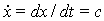 equals lightspeed, then the function Ψ(+) proves to be Lorentz invariant, which means the equations Ψ(±) may be surmised to play a natural role in the domain of quantum electrodynamics.
1. Description of the general solution of CWE(+)
Recall that A 0 is assumed a real constant and C a real function not necessarily independent of x and t. The general solution Ψ(+) to CWE(+), which will be derived in section 4 of this paper, is
 |
(1) |
(or any complex multiple of it) where 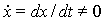 is the (phase) velocity coded into the complex "main phase"
  as well as in the cophase
  . To make Ψ(+) more yielding, we reparametrize it by setting A = 2α / v, C = α2(1 - f 2), with a real or complex scalar (parameter) and α = 2πκ, with κ = 1 / λ a wave number with λ > 0 a wave length. Then takes the more catching form,
 |
(2) |
that identically solves the equation CWE(+), which itself changes to
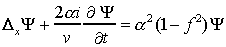 |
(3) |
in the process. Going further down to 'ground zero' of quantum waves, we need to distinguish between what we call in this paper the two main quantum cases and either assume:
- (qi): for velocity v ≠ c ,
 is the positive energy of a moving restmass ≠ 0 particle with momentum
  and mass μ > 0; or
- (qii): for v = c, that E = hν is the energy of a restmass zero particle with momentum p = E / c etc.
The anatomy of Ψ(±) and of CWE(±) can then, in fact, be given with only sparse reference to the actually rather long chain of elementary mathematical arguments used to solve equation CWE(+) in section 4.
Remark 1. One can use and rewrite the solution(2) and equation (3) to three dimensions, replacing the one-dimensional operator 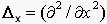 in (3) to become the full three-dimensional Laplacian
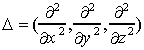 .
. To that end the wave number κ, the space coordinate x, the velocity v and the parameter f should be written as vectors x = (x,y,z), κ = (κx, κy, κz), f =& (fx, fy, fz), the inner product notation adopted for the rewrite of the phases and of the norms that occur in the right hand terms of the equation, in the usual fashion etc...
Remark 2. Equation (2) can be so 'generalized' that the velocities encoded in the two phases are different. One can throw in a factor g by setting

The differential equation then takes the form

(as the same calculation of section 4 shows), and its solution Ψ(±) satisfies the real wave equation

instead of equation (4) below, which obtains for g = 1. The verification of the latter equation is an arduous job.
2. Anatomy of the functions Y(±) vis-à-vis CWE(±)
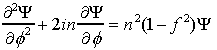
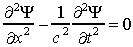
Perhaps the most remarkable feature of Ψ(±) is that for v = c lightspeed, they are invariant for the standard one-dimensional Lorentz transformation. Indeed, since then Ψ±(x, t) are functions of x - ct, they are, by dint of general differential calculus, also solutions of the real one-dimensional wave equation
 |
(4) |
and this one is Lorentz invariant, and hence, so are the complex solutions Ψ = Ψ(±); the implication is that for both signatures, CWE(±) and Ψ±(x, t) are Lorentz invariant as well [Click here to see Footnote 1].
The second feature of Ψ(±) that should be cleared up is the role of the scalar factor f. From its definition, it follows that f writes as a complex function of α (showing f to be non-complex for C ≤ 0 and singular at α = 0). In the main quantum case (qi)--- where mass μ with velocty v, carries energy  αv = μv2 = hv, v the De Broglie frequency---, multiplication of (3) by the factor 2/2μ leads to the equivalent equation
 |
(5) |
whose right hand side has the classical kinetic energy μv2/2 for a factor. Compare
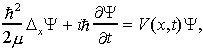
(5) to what is universally known as "Schrödinger's second wave equation"
 |
(6) |
of a quantum particle with mass μ, that likewise is considered to move with velocity v under the action of a potential energy field V(x,t). The two conceptionally different kinds of energy in the right hand sides of the two equivalent equations (4) and (5) may seem paradoxical, but do not hold a contradiction, since the equations merely say that they deal with the same quantum motion, if and only if for all x and t the potential energy V(x,t) of the particle is 1 - f 2 times its kinetic energy. In that case, the two energies are equal if and only if f = 0; this comes close to the case of what quantum theory calls a "free particle" (i.e. |Ψ| = 1, V(x,t) and v constant), as can be directly seen on Ψ+(x, t) as well. It is also clear that phase and cophase of Ψ+(x, t) are equal if and only if f = ±1. In that case we call the wave function and particle "harmonic". By the same token, one can use the parameter f to code specific wave number changing (stationary) dynamics of a particle into its wave function, on account of the following rationale. Clearly, if a particle is not free or harmonic, then there are interacting forces that tend to change the dynamics from being 'free' or 'harmonic' to 'bound'. The effect of these forces is to change the physical properties of the particle (such as energy, momentum, path, wave number, spin, quantum numbers etc.) in a manner that tends show up as a difference between (the wave numbers of) phase and cophase. Semi-classical physics often uses the name "corrections" to denote these changes. Thus, the quantity f makes it possible to write energy corrections due to spin change, the presence of a uniform magnetic field, the Larmor precession (the "Lande factor") etc. etc. into the wave function by way of its cophase, for f is the only parameter in Ψ+(x, t) that comes into consideration to take care of changes of this kind. Indeed, note that the quantity fα plays the same role in the expression of the cophase as the wave number α does in the phase, and that f 'offsets' or 'displaces' the latter by a factor f; and by way of it, alters by the same factor the energy -αv coded in the phase, to the energy -fαv coded in the cophase). It stands to reason that a particular dynamic may define f as a very sophisticated real number. Write that number in the form f = 1 + s; then s measures 'how far' the particle is removed from the harmonic particle with wave number α, since then f(α) = 1 + sα, where s can be positive or negative.
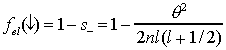
As an example, take the classical Bohr electron in the H-atom, say in the (k, n) -th energy state say with spin down. Then f is known as a number of the form f = 1 - s_ < 1 where s_ > 0 is expressible in terms of the quantum numbers n and k. From Alonzo and Finn [2], p 135 ff., under the heading 'spin-orbit interaction', one readily draws the spin-down f = fel( ) resp. the spin-up f = fel(
 ) values of for the electron in (k, n) -th energy state and get (in terms of the usual quantum mechanical quantum numbering notation, which uses the triples (n, l, j) with integral l = 0, 1... n-1 and half-integral j = l ± 1/2, instead of the Bohrian pairs (n, k)), the up to second order in θ, values
 |
j = l - 1/2 |
resp.
 |
j = l + 1/2 |
where θ = 1/137.036 with 137.036 = c/e2 the atomic-spectral "fine structure constant".
General Remark 1a. Since in this paper, we try to deal with the two equations CWE(±), the general solutions of which are clearly complex conjugate, we cannot avoid the question as to what the physical difference between the two different signatures might mean. The equivalent equations (2) and (3) suggest an answer. They show that the signature change of Ψ+(x, t) to Ψ-(x, t) is accomplished, by either of three operations, viz.
| |
(i) |
by the formal mathematical operation i  -i applied to the exponent of the exponential function (which has the sign change of the second terms of the two equations for consequence), -i applied to the exponent of the exponential function (which has the sign change of the second terms of the two equations for consequence),
|
| |
(ii) |
or by the operation of changing the wave number α to its negative in the main quantum case (qi),
|
| |
(iii) |
by changing the sign of the mass μ, say, in the right- and left-most term of (6), amounting to complex conjugation as well.
|
Below, we show that (ii) and (iii) can be regarded as physical operations in that, in the case of the hydrogenic electron, they change the electron into its antimatter counterpart, viz. the "positively charged electron" or "positron" in the "anti-H-atom". Recall that in quantum mechanics it is widely considered that changing a matter particle to its antimatter counterpart can be accomplished by changing the signs of all the (orbital- and magnetic) quantum numbers that go into the former, to their opposites. In addition, it is regarded a hallmark for particle/antiparticle pairs, to have the propensity of under suitable conditions of proximity and motion to "annihilate" each other (thereby releasing radiation energy). As a result of experiments in high energy physics that regard matter vs. antimatter questions, it is custom to think that every property that applies to a physics vector that is attached to a matter particle and that is 'vectorially inversible', applies in reversed form to the antiparticle of that particle. Examples of vectorially inversible properties of this kind are (i) "spin" ("up"/"down"), (ii) "direction" ("forward" /"backward", in space or time [Click here to see footnote 2] or "up"/"down" in space only), (iii) "parity"(the "righthanded" or "lefthanded" sense of their 3D coordinates), and (iv) (electric) "charge" ("positive"/"negative") etc. Note that it is thereby judged correct to except the (non-vectorial) concepts of energy and mass from this rule: e.g. in High Energy Physics it is rule to apply the ordinary energy (and other) conservation laws with solely positive masses to the dynamics of matter and antimatter particles alike; and there has never been evidence forcing the idea that for instance a neutron and an antineutron would repel each other [Click here to see footnote 3], perhaps because actual repelling effects are likely to be immeasurably small. Thus, in order to keep the energy αv = μv2 = hv of a quantum particle for instance, constant under wave number inversion α -α, we must have either (a): - for the (non-vector) Planck unit of action , or (b): v -v for the velocity or (c): the sign inversion μ -μ of mass. For the change from the hydrogenic electron to the "hydrogenic positron" below, we find that α changes sign if and when the signs of the said quantum numbers are reversed but not the sign of . In fact, we show that the change of the signs of all quantum numbers in the formulas for the electron, needs the additional parity reversal of its 3D coordinates to get a sign change of μ.
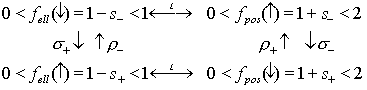
Since we intend to expose the general wave form for a matter particle moving in the "world of matter" as well as the "antiwave form" of its counterpart in the 'world of antimatter', and more precisely, since we intend to show in detail, how the wave function of the hydrogenic electron in (n, l, ml)-th energy state relates to its antimatter counterpart (alias the positron in (-n, -l, -ml)-th energy state in the anti-H-atom), it is of interest to see in what way spinchanges, notably 'spinflips', of the electron affect (the values of) f in the above equations. Thus, recall the halfintegral spin-down resp. spin-up operations σ- : ( l l - 1/2) resp. σ+ : ( l l + 1/2) of the (l, n)-th electron, that leave the principal level n untouched, and check the truth of the formulas:
σ-( fel()) = fel() and σ+( fel()) = fel()
Now define an operation i which acts on the set of all hydrogenic (energy level n, orbital k and magnetic l ) quantum numbers by inverting simultaneously the signs of all their occurrences in the formulas that describe the twobody classical mechanical resp. quantum mechanical formulas holding for the electron-proton interaction of the H-atom [Click here to see footnote 4]:
| |
ι (n, k) = (-n, -k) |
|
(1 ≤ n ≤ k)
|
(7a) |
| |
ι (n, l, ml ) = (-n, -l, -m-l ) |
|
(l = k - 1; -l ≤ ml ≤ l)
|
(7b) |
The following commutation formulas are easily verified:
using i (s±) = -s±.
The map i should enable us to calculate the spin-up and spin-down operators for the positron in the anti-H-atom from the ones of the hydrogenic electron, using the formulas
| |
ι ( fel()) = fpos() |
and |
ι ( fel()) = fpos() |
(9) |
Setting tentatively,
| |
ρ- ( fpos()) = fpos() |
resp. |
ρ+ ( fpos()) = fpos() |
|
for the spin-down resp. the spin-up operators in the anti-H-atom, we find the commutation formulas, analogues of (6):
in which the spin operators ρ± define halfintegral quantum (anti)leaps also:
| |
ρ- : l → l + 1/2 |
and |
ρ+ : l → l - 1/2 |
|
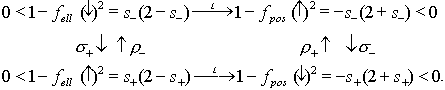
All this can be summed up by the commutative diagrams
and
where, in the second diagram, the sign changes under the operation i should be noted.
Having thus computed the value changes of f resp. 1 - f 2 due to spin for the hydrogenic and 'antihydrogenic' electrons as they enter the cophases of their wave functions resp. the right sides of their equations, we now determine the way in which the quantum numbers enter into the mainphases of the same.
3. The mainphases of the hydrogenic electron and the anti-hydrogenic positron
For our purpose, almost all that needs to be known on the (k, n)-th Bohr electron vs. its counterpart positron, can be seen on the (n, n)-th hydrogenic electron already: this is the electron in principal n-th energy level in ideal circular orbit. We treat that case first and then expound in detail on how the deterministic (n, n)-th Bohr formalism 'generalizes to' the likewise deterministic (k, n)-th formalism, in which the electron is likewise judged to describe a geometrically well-determined path in three-space, namely an ideal elliptic orbit with eccentricity 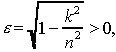 instead of an ideal circle. For x = rφ, the polar equation of the electron in n-th principal-circular orbit, with φ = φ(t) for 'azimuthal' angular function and (constant) orbital radius r = rn, we have the Bohr formula
  where
where  with qe the "elementary charge", i.e. the charge of the electron, ε0 the universal electric constant, and μ the reduced electron mass me. From the constancy of the angular momentum
 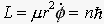 , and from the relations α = 2π / λ = 2πκ and 2πr = nλ, one infers the wave number
  , and thence the formula for the phase of the (n, n)-th electron:
For the wave function of the (n, n)-th electron one then gets
Its equation takes, after multiplication by r 2, the r-free form
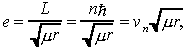
As for the (-n, -n)-th positron with wave number -n / r and phase iS-n = -iSn, one needs only apply time inversion (or, what is the same, the substitution τ(φ) -τ(φ)) to the second term of the equation, since φ(τ) φ(-τ) = -φ(τ), etc. As for the orbital velocity vn = r 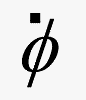 of the (-n, -n)-th electron, one easily computes from the previous formulas the quantized value vn = c /137n, where the number 137 stands for the already mentioned fine structure constant 137.036... = c / e2 and c for lightspeed. Clearly τ(vn) = c /137(-n) = -vn, and the angular momentum L = μrvn changes sign accordingly. (As L = n as well, we cannot have - on top of n -n, as this would mean no change of the momentum.) As for the reversal of the charge e of the electron that should go with τ, it is in this case visible on the formula e2 = L2 / (μr) from which one readily draws the value of e:
 |
(11) |
to conclude that, under the assumption τ(μr)=μr, τ reverses the sign of e! There are but two ways that one may imagine this to happen, viz. (a) τ(μ)=μ and τ(r)=r , or (b) τ(μ)= -μ and τ(r)= -r. Outlandish as (b) may seem, it is nevertheless what one gets when one applies parity reversal P to a 3D coordinate frame for the motion of the electron. Indeed, translated in terms of spherical coordinates (r, φ, θ), the parity reversal operation P maps (r, φ, θ) (-r, φ + π, θ - π). Geometrically speaking this is tantamount to flipping the circle x = r φ in the plane θ = 0 in 3D space about the line defined by φ = π / 4 through its center. Now see what the operation τ o P does to the formula μ = L/rvn in which all three quantities L, r, vn change sign, and get (τ o P)(μ) = τ(μ) = - μ[Click here to see footnote 5] ! The invariance of μr for the operation τ is now clear since τ changes also the sign of the parameter r. Formula (11) is an intricate formula linking the signature change of Ψ+(x, t), at once, to the charge reversal C:e -e and to the mass reversal M:μ -μ of the charged particle. The formula seems to indicate that the well-known quantum mechanical "CPT inversion principle" for charge, parity and time, should be reconsidered to become a MPT inversion principle for mass, parity and time instead, (so that the principle becomes applicable to non-charged particles as well).
Remark on reduced mass: As in all two body mechanics, the above mass is not the mass of one of the bodies, but the reduced mass between the two, in our case electron and proton:
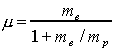
where mp is the mass of the nuclear proton. Since mp is big compared to me, a sign change of μ is the same thing as a simultaneous sign change for the involved pair of masses M(me,mp)(-me,-mp). In addition, if we denote the change to an antiparticle by an overbar, one gets  for the mass of the antiproton.
The change-over from the (n, -n)-th electron to the (k, -n)-th electron sublevel of the same principal level n, means changing from the circular polar representation x = rθ to a polar representation that parametrizes an elliptic orbit instead of a circular one. With the same symbol for the azimuthal angular function, we represent the elliptic orbit by the polar equation
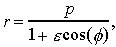
with r the time-dependent radius function that describes the distance between the nuclear proton, that finds itself at one of the focus points of the ellipse, and the moving electron; and a short halfaxis of the ellipse at that focus point (e.g. at the azimuthal value φ = π/4). As in the circular case, we wish to write the elliptic orbit in intrinsic form x = pε Φ (k, n, t), for some constant length pε and angular function Φ (k, n, t), in order to keep clearly track of the 'generalization' from the (n, -n)-th to the (k, -n)-th case. To that end, we need the formula for the energy of the proton-electron elliptic 'twobody motion' for arbitrary Bohr level (k, -n). It is the negative-definite energy function E(n, r, φ) = μ( + r)/2 - e2 /r, which represents the separation energy between proton and electron for every sublevel (k, n) with 1 ≤ k ≤ n. As in the circular case, the angular momentum L = μr2 is again an orbital constant, and so is E(n, r, φ), say E(n, r, φ) = -En , with En > 0. Recall the formula
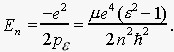
Use the relation e2 = L2 / μp to show that there is an indefinite action integral of the form

that, trivially, is equal to 0; and show by integration, that the function Φ = Φ(k, n,φ(t))[Click here to see footnote 6] is a real angular function with the properties: (i) for k = n , i.e. ε = 0, one is back to the (n, -n)-th case, with Φn(n, n,φ(t)) = φ(t) = vn = c/137n, etc., (ii) 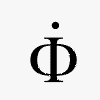 (k, n,φ) = -2En / L is a constant angular frequency, and (iii) Φ is everywhere invertible in φ, since it has the nowhere vanishing function
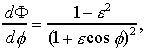
for the derivative.
Now choose pε = p / (1 - ε2) as the radius-to-be of the circular motion (representing the elliptic motion we are looking for), with polar representation pε Φ (k, n, φ). Clearly, pointwise speaking, this circle is the image of the ellipse under the one-to-one invertible point map (r, φ) (pε Φ (k, n, φ)) defined by the integral

It is also a uniform cicular motion, since, on one hand, Φ = Φ (k, n, φ)) is by way of φ = φ (t ) a continuous function of time t. On the other hand, the integral implies the uniformity of this motion, on account of the easily derived relationships  , i.e. the above property (ii). Since we have the equality
 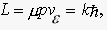 we may compare with e2 = L2 /(μp) to conclude that the velocity vε = c /137k, depends on k alone. That is why we set vε = vk from now on. We wish also that one could set p = pk depends on k alone. Indeed, one can, since the definition of vε implies = c /137kpε, meaning we can compare with L = μppε and recuperate, with the help of the well-known relation e2 = c /137 the Bohr radius formula for the principal level k thus
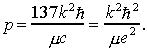
This justifies the notation p= pk, and yields pε = pn. We now show that the expression

divided by is a main phase, at once, for the elliptic motion and for its image circle motion  Now, recalling that the classical revolution time period of the elliptic electron motion is given by

feed the coordinates l = T and φ = 2π of the end point of a full period into the expression. One gets  since
since  and[Click here to see footnote 7]
  This completes the argument that S = 0 is, at once, a linear(ized) equation for the elliptic and circular image motions, and that the physically dimensionless expression
  is a phase for both, thus:

| with |
 |
the (k, n)-th wave number. The wave function for the hydrogenic electron, say with spin up, now writes:

with equation
 |
(12) |
so that the wave function of the 'hydrogenic positron' after applying the map  (together with time inversion which makes good
  as well), as in the (-n, -n)-th case, writes as:

with equation
 |
(13) |
whose left hand side has negative signature contrary to (12). Here, P takes care of the double charge- and mass reversals in a slightly different manner from before. Parity reversal is again flipping the ellipse about the line  through the focus. One has
  on account of P(r) = -r, P(p) = -p, P(ε) = ε, P(r2) = r2, and the reversal of L due to τ; the formula
  that comes instead of
  gives the result.
Remark. One can get Spos also by applying the operation MPT, alias triple of substitutions as announced in the Abstract, to Sel. The effect is changing the sign of the phase three times in a row. The sub-substitution MP then is responsible for changing the charge.
4. Proof of the wave solution Y+(x,t)
We solve the wave equation CWE (+) with any real constant A 0 of later to determine fictive physical dimension, and C a real function that is not necessarily independent of x and t, in Madelung's fashion (cf.[1]) by a single-valued exponential function of the form Ψ = eR + iS, with R = R(x,t) and S = S(x,t) real scalar functions, subject to the assumption 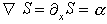 is a real constant. We write
  throughout. Now, substitute Ψ = eR + iS into CWE (+); then, splitting into real- and imaginary parts gives rise to the two non-linear partial differential equations (named after S. Madelung [1]):
| ME 1 | |
 |
| ME 2 | |
 |
the first one of which is called the "continuity equation", and in the second one of which the sum of the two terms with R is traditionally called "the quantum mechanical potential" --- even though the physical dimension of all five terms is m-2 with x for the dimension of length m.[Click here to see footnote 8]
From the first equation one concludes that R = R(ξ) is a function of ξ, where  . This makes S = S(x,t) into S = S(ξ, t) etc. Since on functions of ξ the operators
  and
and  have the same effect and
  is constant, one concludes that the left side of ME 2 can be expressed as
  . It follows that S = S(x,t) writes as a "dimensionless phase"
 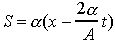 , provided that we put 2α/A = v with v equal to a "phase velocity" of dimension ms-1 while assigning to A formally the dimension m-2s.
We can now compute R from ME 2 as a function of ξ for any function C that is not, for whatever v, writable as a function of ξ = x -vt in the following manner. Since 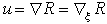 is a function of ξ alone, ME 2 writes as a solvable ordinary differential equation in ξ , thus
Its general solution is
|
 |
(14) |
with  chosen on the real positive branch of the radical function, for arbitrary constant phase angle γ. Put w = fα and keep 2α/A = v with unaltered dimensions. Then
 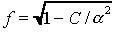 is a physically dimensionless number. Use the well-known formula
to get R by integrating (14). One gets
and Ψ takes the form
in the process.
References
[1] S Madelung "Quantentheorie
in hydrodynamischer Form" Z. Phys. 40 322-326 (1926).
[2] M.Alonzo \& E.J.Finn,
Fundamental University Physics 3 Volumes Vol. III, Quantum- and Statistical
Physics Addison-Wesley, Reading, Mass.(1980).
[3] L D Howe Symmetry Between Gravitational and Electric Forces,
www.innovationgame.com/physics (2000).
[4] W Kuijk-Grünbauer Fourth fundamental ("hybrid") force acts between mass and
charges and amalgamates electromagnetic and gravitational fields (to be submitted).
www.innovationgame.com/physics/kuijk/particle.htm April 2002