
www.innovationgame.com/physics/letters/lett002.htm May 2003
|

Symmetry, Gravitation and Inertia
| This letter is published on the World Wide Web under the strict condition that it is the author's copyright. Any use, or copying, of any part of its contents, or the author's original ideas, is allowed only on condition that it is acknowledged by citation to be the work of the original author. |
This letter offers a way to support the detailed analysis of Prof. Kuijk-Grünbauer, while explaining well documented experimental facts. Although Newton was able to unite gravitaional mass with inertial mass, this can only apply in a universe where there is no symmetry between charge and mass. The development of Prof. Kuijk-Grünbauer's analysis leads naturally to three sets of Maxwell equations.
The mathematical analysis that you have used offers a practical way to overcome the asymmetry associated with "normal" physics. However, there is a set of physical observations that it does not appear to explain and, indeed, are counter to your arguments. That does not mean that the analysis is wrong, only incomplete. To illustrate the problem let me describe a physical experiment. For simplicity I have used a thought experiment, but it reflects a real, physical situation.
Consider three pairs of particles, such that the particles in each pair are identical to one another. Let the pairs be characterised as follows:
| Pair | Mass / Mp | Charge / qe | Separation / m |
| 1 | 1 | 1 | 0.1 |
| 2 | 4 | 2 | 0.1 |
| 3 | 12 | 6 | 0.1 |
Table 1: Particle pairs for the thought experiment
These could represent respectively, protons, alpha particles and stripped carbon nuclei, such as those produced in a tandem Van der Graaff generator. Assume the particles are initially held at rest and then allowed to accelerate under electrostatic repulsion. The observed acceleration on each particle for each pair would be respectively, 13.8 ms-2, 13.8 ms-2 and 41.3 ms-2. This corresponds to the equation
|
|
(1) |
where a is the acceleration and the other symbols have there usual meaning. Now, in Newtonian mechanics, force is normally defined as the product of mass and acceleration. The dimensions of acceleration, a, are

|
(2) |

|
(3) |

|
(4) |
where sp, the dreaded spon, is the unit of inertia (numerically equal to mass for "pure" positive mass, but NOT for negative or mixed masses). So in all three cases, the dimension of K is a new Newton (Nn) with dimensions
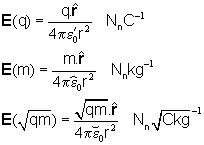
I conjecture that your three formulae for E now become (with
 having the usual meaning of a unit vector in the direction of r):
|
(5) |
The dimension of E in all three cases is now new Newton's per source unit. It is the natural dimension, because the electric field acts on an electric charge, the gravitational field acts on a gravitational "charge" and the hybrid field acts on a hybrid "charge". This now fully preserves your symmetry, but allows the effect of charges to act on masses, as in the thought experiment above. It also fits exactly with established electric field theory.
The hybrid field would only be observed to be of any significance where there are relatively large masses together with small charges. Calculations suggest that, for two identical particles with positive mass (where inertia is numerically identical to gravitation), a mass to charge ratio of  ). If the mass to charge ratio is much greater, Newton's law dominates and if it is much smaller, Coulomb's law dominates. Of course, for like charges and like gravitation, the components from Newton's law and Coulomb's law would be opposite and therefore cancel. So the question is (that we have not yet addressed) "what is the sign of the force associated with the hybrid law?" Remember that the sign for Newton's law (for repulsion) is negative, while that for coulomb's law is positive (vice versa for attraction). That is to say, for gravitation, like charges attract and unlike charges repel, whereas for electric charges, unlike charges attract and like charges repel. Because of the square roots in the hybrid law, does this mean that the force is imaginary and therefore tangential?
Going back to your equations (6) we now get:
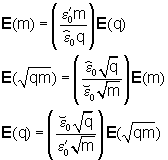
|
(6) |
Where the bracketed expressions are (dimensionless) scalars. This corresponds exactly to your equations 6. Note that we can also write a corresponding set of transposition equations for K, which explain the calculated mass to charge ratio for a pair of identical particles, as noted above:
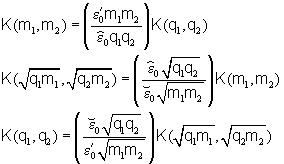
|
(7) |
When we get to your Equation 7, I see a deeper problem. Let us consider two charges, q1 and q2 and two observers O1 and O2. Let q1 move at velocity v with respect to q2, and assume that O1 is moves in the same frame of reference as q1 while O2 moves in the same frame of reference as q2. Now, from the point of view of O1, the B field for q1 will be zero and the B field for q2 will be non-zero, whereas for O2, the B field for q2 will be zero and the B field for q1 will be equal in magnitude and opposite in direction to that observed by O1 for q2. B1 does not, of course, depend on q2, but it does depend on the relative motion of O2, moving in the same frame of reference as q2. This may be an artefact of Einsteinium relativity, which I feel we must address at some stage.
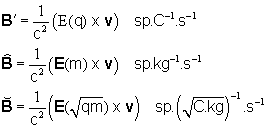
Using my proposed dimensionality, the dimension of
 is
is
 . Without this dimension it is not possible to explain the effect of the mass (inertia) to electric charge ratio under the influence of a magnetic field, such as within a mass spectrometer or a bubble chamber. This leads to the set of equations:
|
(8) |
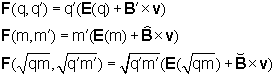
All three will be equal if the mass to charge ratio (with positive mass, where inertia is numerically identical to gravitation) is  , as you correctly assert. Consequently, this leads to a triplet of equations for the Lorentz force (F):
|
(9) |
Note that the dimension of F is the same in all three cases, namely
I now propose three sets of equations:
| IE (The "First Gauss Law") |  |
with each term of dimension sp.C-1.m-1.s-1 |
| IIE (The "Second Gauss Law") |  |
with  the "charge density" of dimension Cm-3 and overall dimension of terms sp.C-1.s-2 the "charge density" of dimension Cm-3 and overall dimension of terms sp.C-1.s-2 |
| IIIE (The "Faraday-Henri Law") |  |
with overall dimension sp.C-1.s-2 |
| IVE (The "Maxwell-Ampère Law") | 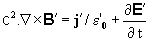 |
with  the "electric current density" of dimension C.m-2.s-1; each term of dimension sp.C-1.m.s-3 the "electric current density" of dimension C.m-2.s-1; each term of dimension sp.C-1.m.s-3 |
| IG |  |
with each term of dimension sp.kg-1.m-1.s-1 |
| IIG |  |
with  the "gravitation density" of dimension kg.m-3 and overall dimension of terms sp.kg-1.s-2 the "gravitation density" of dimension kg.m-3 and overall dimension of terms sp.kg-1.s-2 |
| IIIG |  |
with overall dimension sp.kg-1.s-2 |
| IVG | 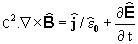 |
with  the "gravitational current density" of dimension
kg.m-2.s-1; each term of dimension sp.kg-1.m.s-3 the "gravitational current density" of dimension
kg.m-2.s-1; each term of dimension sp.kg-1.m.s-3 |
| IH |  |
with each term of dimension sp.( )-1.m-1.s-1 )-1.m-1.s-1 |
| IIH |  |
with  the "hybrid density" of dimension the "hybrid density" of dimension  .m-3 and overall dimension of terms sp.( .m-3 and overall dimension of terms sp.( )-1.s-2 )-1.s-2 |
| IIIH |  |
with overall dimension sp.( )-1.s-2 )-1.s-2 |
| IVH | 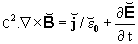 |
with  the "hybrid current density" of dimension the "hybrid current density" of dimension  .m-2.s-1; each term of dimension sp.( .m-2.s-1; each term of dimension sp.( )-1.m.s-3 )-1.m.s-3 |
I think these represent, respectively, what you call "the Maxwell equations for the electric platform", "the Maxwell equations for the gravitational platform", and "the Maxwell equations for the hybrid platform".
|
www.innovationgame.com/physics/letters/lett002.htm May 2003