 , that somewhat later on was experimentally found to have in vacuum the numerical value
www.innovationgame.com/physics/letters/resp1.htm May 2003
|

A Re-dimensionalization of Physics holding unified Physical Fields producing a purely gravitational Lorentz Force
| This letter is published on the World Wide Web under the strict condition that it is the author's copyright. Any use, or copying, of any part of its contents, or the author's original ideas, is allowed only on condition that it is acknowledged by citation to be the work of the original author. |
In this letter we follow a suggestion by R. Feynman to the effect that a re-dimensionalization of Physics may be helpful to solve problems that seem intractable with the physical notions within the framework of the mksC system of units and dimensions. A special re-dimensionalization is shown to reproduce the Coriolis force of Newtonian mechanics as a component of a novel "gravitational Lorentz force" in the context of a "unified field theory".
In a universe 'inhabited' only by pure Newtonian masses of dimension kg, no mechanics in the classical Newtonian vein can engender an entity the physical dimension of which contains the Coulomb unit C.
Pure and consequent application of the "Symmetry principle" between classical- and electric mechanics as suggested by L.Howe, means:
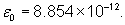
The "cause" of the asymmetry has been Coulomb's decision to accord, within the context of his "electric mechanics", the Newtonian physical unit kg a place that it did not necessarily deserve, namely in the dimension m-3kg-1s 2C of the well-known "dielectric constant", , that somewhat later on was experimentally found to have in vacuum the numerical value
|
In a few earlier proposals I have been arguing that one might for dielectric constant have better taken the expression

|
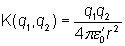
whose dimension takes a natural place in the purely electrical universe I. In terms of electric dimensions Coulomb's law would have then come out symmetric to the (for the occasion, algebraically rewritten) Newtonian law as follows:
| Coulomb's law: |
|
(in Nc = mCs-2) | (1) |
(where q1 and q2 are like charges in C with separation r),
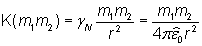
| Newton's law: |
|
(in Nc = mCkgs-2) | (2) |
(where m1 and m2 are positive or negative masses in kg with separation r for  , Newton's constant),
and  the "diagravitational constant" of the same vacuum that thought attaches to a 'mass universe ' as well as to a 'universe of charges'. The beauty of this symmetry between definitions (1) and (2), and its implied re-dimensionalization of the fundamental laws is that they only affect the dimensions of concepts (but not their magnitudes and their algebraic relationships) in the first place, meaning that one can compare (quantities of) gravitational Newtons N that occur in classical mechanical formulas, with (quantities of) electrical Newtons NC that occur in the new electrical mechanical formulas within the electric paradigm, in the same manner as one may compare quantities of apples and pears refraining from comparing an apple to a pear as such

|
is a cross-force that 'builds from (1) and (2)', in this sense that from it one can formally recuperates (1) and (2). To that end, an inveterate algebraist is immediately led to put q = q1 = q2 in (1) and m = m1 = m2 in (2) and take the geometric average of the resulting two forces and find a new hybrid force formula

|
in |

|
(1,2) |
which does the job since, formally, for  and
and  one recovers (1) and (2). Calculation of the 'hybrid permittivity in vacuum'
  , alias "the diahybrid constant" that is given with this formula, leads to

|
and shape comparison of (1,2) with (1) and (2), counting that the entry  must have dimension
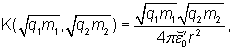
  , we conclude that (1,2) is a third "inverse square law of force" holding for "charged masses", i.e. entities that are mathematically represented by expressions of the form with physical dimension . As an intertwinement of the fundamental laws (1) and (2), formula (1,2) hands us the following conclusions:
 and
and  , which are at separation r, is given by
| Hybrid's law: |
|
(3) |
 .
.

|
(4a) |
| with |

|
(4b) |
This shows that  is physically implied by the fundamental laws (1) and (2), and is not an artifice of imagination. So acts as soon as q and m are brought together into one medium with a permittivity,
  , that averages the permittivities that applies to any two charges and any to two masses in that same medium.
In what follows we will use the following terminology to discriminate between the three parts of Physics that we have distinguished in the above.
 units, as defined and exhibited in the previous lines of text.
The greatest reward of Symmetry however is the unification of the electric, gravitational and hybrid fields that are in the usual fashion attached to the platforms of formulas (1), (2) and (3) respectively. They share the dimension of "acceleration", ms-2 The fields are respectively
| For q any charge; |
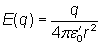
|
(E1) |
| For m any mass; |

|
(E2) |
For  any charged mass; any charged mass; |
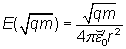
|
(E3) |
where (E3) is the geometric average of (E1) and E2), so that for fixed charge q and mass m, these fields are scalar multiples of one another. Namely, one readily verifies the identities
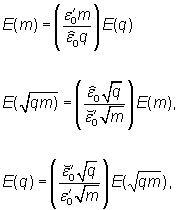
|
(6) |
where the bracketed expressions are (dimensionless) scalars. Recall from standard Maxwell theory, which concerns the electric platform and electric fields E(q), the deep result, that when q moves, say with velocity vector v, then there is a magnetic field that 'twines' with E(q) and writes

|
(7) |
perpendicular to the electric field and v. Clearly, with the present dimensionalization, B(q) gets the dimension of (angular) frequency s-1 instead of the "old" tesla  ; this gives reason to rewrite it with the Greek symbol for 'angular frequency' as follows

|
Recall also that in the static case (v = 0) there is no such magnetic field. It is important that (7) multiplied with the scalar from (6), first formula, yields for an arbitrary moving mass m on the gravitational platform also an angular frequency field (of dimension s-1 ),
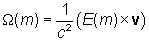
|
which accompanies the (moving) gravitation field E(q) of the moving mass m.
It is noticeable that a given arbitrary angular frequency field  need not, for a charge q or a mass m, be a twin field of the form
  or
or  associated to an electric field E(q) or a gravitational field E(m). However, an equality of the form

|
is possible, namely if

|
and this is the case for and only for the charge to mass ratio
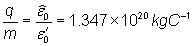
|
(cf (6)) |
Back on the electric platform, recall that the electric force (of dimension NC), exerted on a charge q', which is at separation  from q , is the well-known "Lorentz force"

|
(8) |
where the summand

|
comes, thanks to the relative motion of q with respect to q', in addition to the re-dimensioned "centripetal" Coulomb force
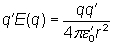
|
This Coulomb force in turn, according to electric theory, may drive centripetally any possible motion between the two charges q and q'. More generally, it should be recalled that all the electromagnetic dynamical events that relate the charges q and q' and their fields, are described by the Lorentz force (8) and the four relativistically invariant Maxwell equations that connect the field pairs  and
and  . Changing to the gravitational platform, it follows that there is similarly a "gravitational Lorentz force"

|
(9) |
between any moving mass m and any other mass that are at separation . Thus, since any circular kinematic motion of m' with respect to m can be simulated by a dynamic with central force  and centripetal acceleration
  , the Lorentz invariant force (9) can be made to comprise what in Newtonian mechanics goes under the name "Coriolis acceleration" as follows. Let m' run in a plane circle of polar representation
  around m with central Newton force
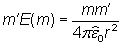
|
and tangential velocity  Its constant angular momentum writes
  and has magnitude
  . Now assume m' moves on the radius
  with speed
  , necessarily with constant
  , towards or away from m, then the angular momentum of m' changes. This change of momentum defines a torque
  , where FC is by definition the Coriolis force. One has

|
and

|
(10) |
The force FC, which in this case is tangential to the circular motion in the same plane, can be added to the right hand side of (9) and tends to increase or decrease  according as the radial velocity v' is pointing towards m (
 ) or away from it (
 ).
).
Remark. One can, conversely, also get  as a radial Coriolis force pointing towards m or away from m, by adding or subtracting v' to the tangential velocity v in (9), or make, more artificially and as it seems, contrary to the grain of experiment, the mass m to depend on time t. We leave this as an exercise to the reader.
The uniformity of the field laws (E1-3) for the three platforms suggest uniformity of the Maxwell theories for these platforms. Indeed, one can get get these uniform equations from the four standard electromagnetic Maxwell equations by redimensioning the entries of the physical constants that occur in these, and simultaneously redimension the field entries. Recall the four Maxwell equations for an arbitrary electromagnetic field pair (E,B), and the dimensions of their terms.
 , with each term of dimension
  ,
, , (with
  the "charge density' of dimension m-3C and each term of dimension
  ),
), , with dimension
  for each term,
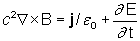 (with j the "electric current density" of dimension
  and each term of dimension
  ).
).The proposed re-dimensionalization of these laws is obtained by subsituting  in the dielectric constant , which then goes into
  , turning the pair (E,B) into a redimensioned pair, say
  on the electric platform, with laws:
 , with each term of dimension
  ,
, , (with the "charge density' of dimension m-3C and overall dimension of terms s-1),
 , with overall dimension s-1,
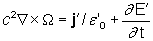 (with j' the "electric current density" of dimension each term of dimension ms-3).
Note. Recall that E' has dimension ms-2, and B' the dimension s-1. Notice also that only the replacement of C by  , respectively by kg, in the dimensions of these equations, which as before, carry
  into
into  and into
  respectively, deliver, what should be called "the Maxwell equations for the hybrid platform", and "the Maxwell equations for the gravitational platform", respectively
in the dimension, and thence to the purely gravitational platform by  .
.
|
www.innovationgame.com/physics/letters/resp1.htm May 2003