www.innovationgame.com/physics/photen.htm January 2003
Momentum Transfer by Photon Transport
L D HOWE
Serco Assurance,
B150, Harwell, Didcot, Oxon., OX11 0QJ, UK
PACS Numbers: 02.50.Wp, 03.65.Bz, 05.60.Gg
|
This paper is published on the World Wide Web under the strict condition
that it is the author's copyright. Any use, or copying, of any part of its
contents, or the author's original ideas, is allowed only on condition that
it is acknowledged by citation to be the work of the original author.
|
|
This paper is solely the work of the author and is not an official publication of Serco Assurance. It in no way represents the official work or policy of Serco Assurance.
|
Abstract
This paper sets out to demonstrate that it is possible that photons have inertia and that this can be transported to other particles. Using this premise, it is possible to account for the phenomenon of special relativity using quantum mechanical principles. It also proposes that an adaptation of the revised relativity equation [4] can be used to describe relativistic behaviour in a two-particle universe. It is shown that, if photon transport is the means of transferring kinetic energy in an elastic collision, it must obey a constant momentum relationship, rather than a constant energy relationship. If kinetic energy transfer is driven by a constant momentum relationship, there will be a transient energy deficiency, with the energy stored as some form of potential energy during the interaction. The idea of constant momentum transfer agrees with the Galilean concept of relativity. By referring to the momentum of a complete system, rather than that of an individual component, we demonstrate that all observers will agree about energy dissipated. The equations for energy deficiency developed for elastic collisions are used to demonstrate this. The principle of momentum transfer by photon transport may help to unify special relativity, quantum mechanical principles and Newtonian mechanics.
1. Introduction
Howe [1] has postulated the existence of a De Broglie vector together with a property of photons described as mass equivalence. The De Broglie vector has been used to describe the wave like properties of quantum particles [2, 3]. A revision of special relativity [4] has developed arguments for the observation of constant energy change for photon emission and absorption by observers in different frames of reference. These two postulations have led to the idea of negative mass [5], the existence of which has been demonstrated theoretically by Kuijk-Grünbauer [6]. Howe has further demonstrated, by means of simulation, that photon transport is a feasible means of thermal conduction [7]. This paper develops these ideas further by postulating the transport of momentum by photons.
Reference is made throughout this paper to the photon as the vehicle for the transport of momentum and energy. However, a new theoretical development by Kuijk-Grünbauer [8] proposes that there may be a triplet of such particles, related by parallel laws. These are the photon, the graviton and a hybrid particle. It is not yet clear either what the full inter-relationship between these particles might be, or what their respective roles would be in the conversion of one type of energy to another. Kuijk-Grünbauer has suggested that the graviton may be a more appropriate particle for the transport of momentum. However, until the roles of the various forces are better understood and the concept more widely accepted, the term photon will continue to be used by the author. The nomenclature may need to be revised in the light of future theoretical developments.
2 Photon Inertia
The hypothesis that photons have negative mass leads naturally to the idea of photon inertia, which is depicted here by the symbol Ip. We use the term particle here to describe a cohesive collection of one or more quantum particles with positive (attractive under gravity) mass. If a photon has negative mass (mutually attractive, but repulsive to positive mass), it will interact with a particle in one of two ways:
- The mutual repulsion will be sufficient to cause the photon to be repelled, with the effect of reflection or scattering;
- The photon will be absorbed into a potential well from which it cannot immediately escape, increasing the energy and inertia of the particle.
In the first case, the particle will normally be left effectively undisturbed, because the inertia of the photon will be many orders of magnitude smaller than that of the particle, resulting in elastic scattering. However, in the case where a very low mass particle, such as an electron, interacts with a photon of very high energy, namely a gamma, there may be some energy transfer between the photon and the particle, resulting in observed inelastic scattering. In the second case, all of the energy will be added to that of the particle, as will the inertia. The case where photon energy and inertia are added to the particle is considered in more detail in the next section. The argument assumes that the absorption of more than one photon will lead to the simple addition of their individual inertias.
3 Implications for Kinetic Energy
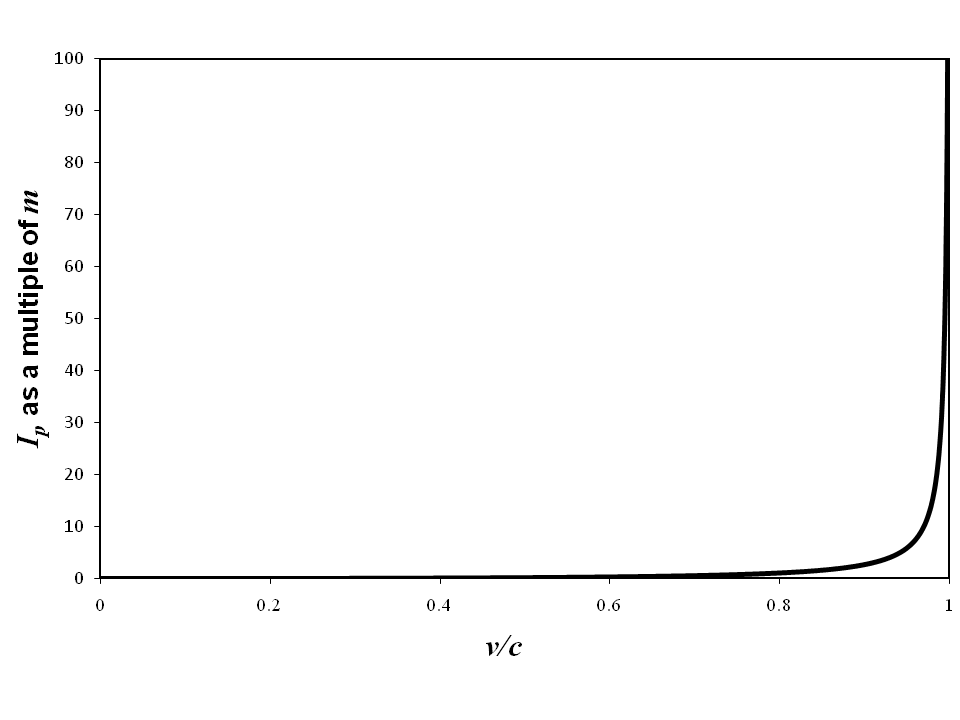
In Newtonian terms, the kinetic energy, KE, of a moving particle is given by the formula KE = 1/2.mv2, where m is the rest mass of the particle and v is its velocity. However, if the photon inertia is added to the inertia of the particle this formula becomes KE = 1/2.(m + Ip) v2. The concept of photon inertia leads to the alternative formula for the energy of a photon KE = 1/2.Ip c2. Thus if the hypothesis of energy transport by photons is accepted, we can equate the kinetic energy of the particle with the energy added by photon transport:
| |
|
1 |
| Thus |
|
2 |
| So |
|
3 |
| And |
|
4 |
| Which reduces to |
|
  |
5 |
Thus KE becomes unbounded as v approaches c. This demonstrates that the relativistic equation for kinetic energy can be derived from quantum mechanical principles. Rearranging Equation 5 we can write:
| |
|
6 |
| Giving |
|
7 |
| Which reduces to |
|
  |
8 |
Equation 8 confirms that light speed can only be achieved by a particle with zero rest mass. Hence we deduce that a photon has zero rest mass, but has inertia (and negative mass) due solely to its motion. It can also be seen from Equation 8 that the velocity of such a photon will always be c relative to the frame of reference from which it is emitted (in fact, this is implicit in the definition of Ip). By substituting the relativistic equation for rest mass, ER = mc2 we arrive at:
| |
|
9 |
4 A Two-Particle Universe
Consider a universe in which only two identical particles, A and B, exist and the sole means of energy transport is photons. The above analysis appears to produce a paradox similar to the well-known twins paradox of special relativity. If both bodies start in the same frame of reference and Particle A accelerates to a new frame of reference, with velocity v, as seen from Particle B's frame of reference, Particle B will perceive that A has gained energy KE = 1/2.mv2c2/(c2 - v2) (from Equation 5). Thus for Particle A to return to Particle B's frame of reference, either Particle A must lose energy, E or Particle B must gain energy E. However, from Particle A's frame of reference, the converse is true.
One way to resolve the paradox is as follows. In such a two-particle universe, the only "fixed" point would be the centre of mass of the two particles. Hence, if one particle were to move in the "fixed" reference frame, the other would move in an equal and opposite direction. Thus both particles would need to gain energy for any movement to occur. However, for a two-particle universe, with both particles at rest, there would be no source of photons to cause a change in energy. This problem can be overcome by introducing the concept of notional velocity for a relativistic case. Consider Equation 9. If we set KE = ER, Equation 9 reduces to (v/c)2 = 2/3. If we set this as the notional velocity we now have (from Equation 3) IP = 2m, which means that energy can be transferred from one particle to the other. We have now defined four frames of reference:
- The frame of reference of Particle A;
- The frame of reference of Particle B;
- The frame of reference of the centre of mass;
- The frame of reference of the notional zero velocity.
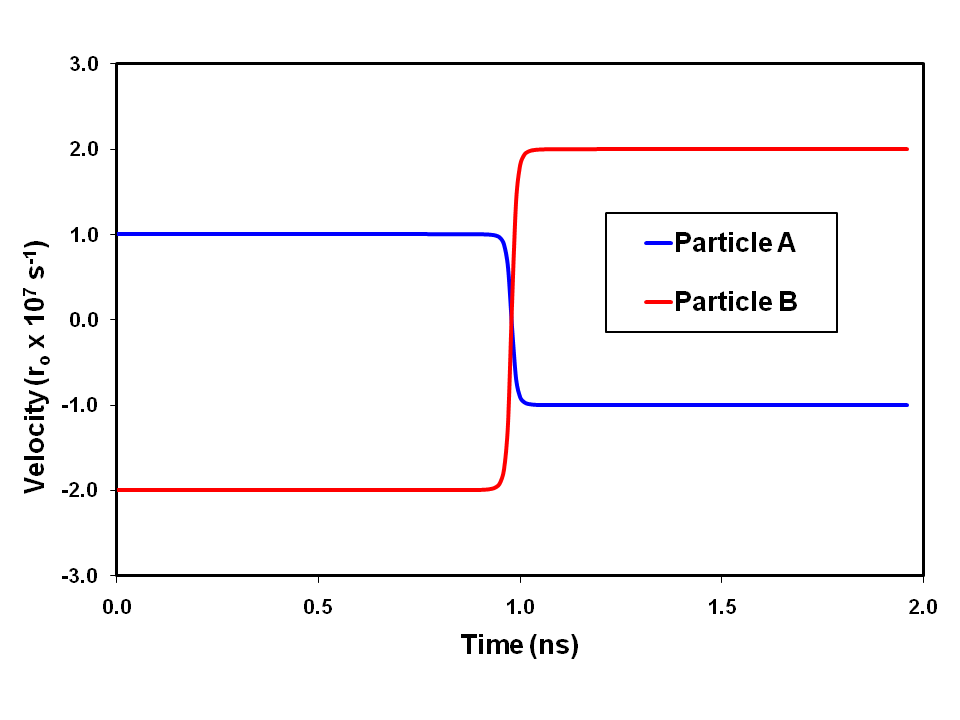
The simplest view is from the frame of reference of notional zero velocity. From this frame of reference, the velocities of the two particles can be plotted, as Particle A transfers energy to Particle B (see Figure 1). The transfer will continue until the velocity of Particle A falls to zero. Thereafter, the process of continued acceleration of both particles continues in Reference Frame 3 as Particle B transfers Energy back to Particle A. When Particle B returns to the state (v/c)c2 = 2/3, Particle A will have a velocity of (v/c)c2 = -2/3. This represents the maximum velocity of recession between the two particles. As Particle B continues to transfer energy to Particle A, the difference between the velocities of the two particles will be reduced until they are both again equal at (v/c)c2 = -2/3, with both once again restored to rest mass energy.
|
Figure 1: Velocities of two particles in a two particle universe, assuming that, at rest, both particles have a notional velocity v/c = (2/3)1/2
Another way understand the effects of an energy transfer between the two particles is to consider it from the viewpoint of Howe's equation for a(u, v) [4]:
| |
|
10 |
In the case of the two-particle universe, a(u, v), is the velocity of Particle B as observed in Reference Frame 1, u is the velocity of Reference Frame 4 as observed in Reference Frame 1 and v is the velocity of Particle B as observed in Reference Frame 4. In the original derivation of the equation, it was considered from the point of view of the emission of a photon from a body moving in a reference frame with velocity u with respect to the reference frame of an observer, with v as the velocity of the photon in the reference frame of the emitting body. To adapt this equation for the two-particle universe, it is a requirement that there should be symmetry between the two particles. Fortunately, the term v + u(1-v/c) expands to u + v - uv/c. We need to consider that, for a two-particle universe, there is a crossover at u + v = 0 and we also need to take the negative root when u + v < 0, so Equation 10 becomes:
| |
|
11 |
There is a special case, because the function (u + v)/çu + vç has a discontinuity at u + v = 0, so a(u, v), must be set to zero when u + v = 0. The results for a(u, v), are tabulated against u and v in Table 1, with a(u, v), u and v all normalised to c.
| u/c |
v/c |
| -1.00 |
-0.75 |
-0.50 |
-0.25 |
0.00 |
0.25 |
0.50 |
0.75 |
1.00 |
| 1.00 |
0.00 |
0.661 |
0.866 |
0.968 |
1.00 |
1.031 |
1.118 |
1.250 |
1.414 |
| 0.75 |
-0.661 |
0.000 |
0.500 |
0.661 |
0.750 |
0.834 |
0.952 |
1.093 |
1.250 |
| 0.50 |
-0.866 |
-0.500 |
0.000 |
0.354 |
0.500 |
0.637 |
0.791 |
0.952 |
1.118 |
| 0.25 |
-0.968 |
-0.661 |
-0.354 |
0.000 |
0.250 |
0.442 |
0.637 |
0.834 |
1.031 |
| 0.00 |
-1.000 |
-0.750 |
-0.500 |
-0.250 |
0.000 |
0.250 |
0.500 |
0.750 |
1.000 |
| -0.25 |
-1.031 |
-0.834 |
-0.637 |
-0.442 |
-0.250 |
0.000 |
0.354 |
0.661 |
0.968 |
| -0.50 |
-1.118 |
-0.952 |
-0.791 |
-0.637 |
-0.500 |
-0.354 |
0.000 |
0.500 |
0.866 |
| -0.75 |
-1.250 |
-1.093 |
-0.952 |
-0.834 |
-0.750 |
-0.661 |
-0.500 |
0.000 |
0.661 |
| -1.00 |
-1.414 |
-1.250 |
-1.118 |
-1.031 |
-1.000 |
-0.968 |
-0.866 |
-0.661 |
-0.000 |
Table 1: Results for a(u, v), calculated from Equation 11 for various values of u and v. All values are expressed as fractions of c.
In the extremes where u = v = ±1, a(u, v), represents the view of one photon from the reference frame of another photon moving in the opposite direction, with both u and v respective to the notional reference frame. The case where v + u = 0 represents two particles at rest with respect to one another.
5 Conservation of Momentum
It is clear from the above discussion that momentum is not conserved a priori. Indeed, for any two particles, if one transmits energy to the other by means of photon transport, resulting in a transfer of kinetic energy where there is no other interaction, momentum cannot be conserved. If the theory of energy transport by photons is to be substantiated, it must explain the conservation of momentum during non-relativistic elastic collisions. To understand this, we need to consider the energy transport process as two particles approach one another. Consider the situation where the energy transport process takes place according to some law:
| |
|
12 |
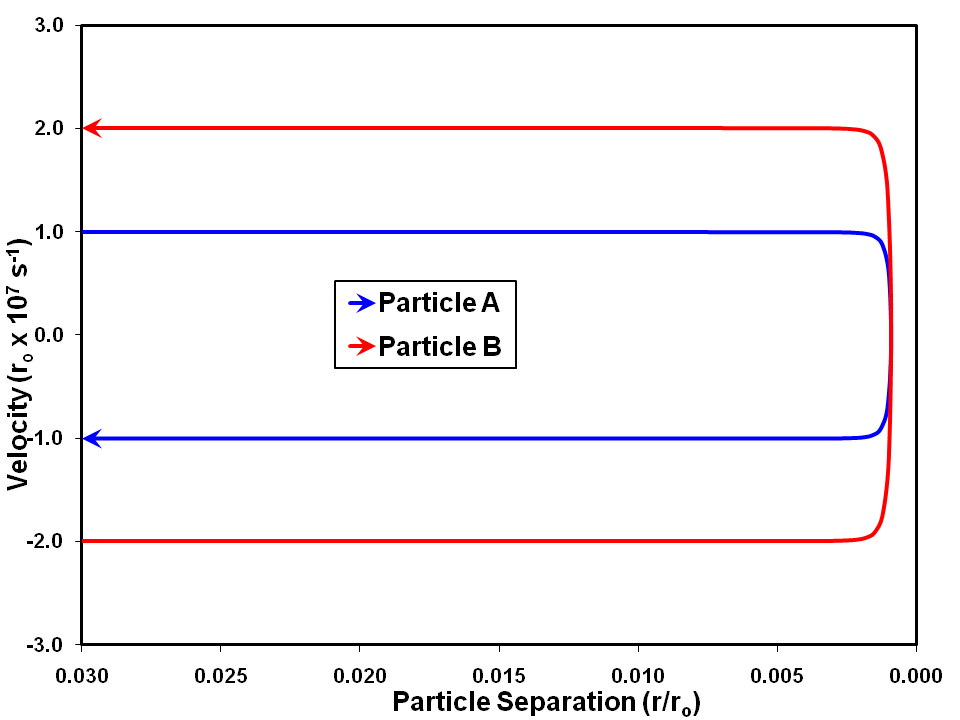
Where dP/dt is the rate of momentum transport with respect to time and f (x) is some function of x, the separation between the particles. To illustrate the above mechanism, Equation 12 has been calculated for two particles in one dimension using f (x) = k(ro/r)6 - k(ro/r)2, with particle masses mA = 2, mB = 1, initial velocities vA = 4 x 10⁷ x ros-1, vB = 1 x 10⁷ x ros-1 and initial positions xA = 0, xB = 10-4 x ro. In this case, the arbitrary constant, k, was set to 1. The calculations were performed using Digital FORTRAN, with a time step of 10-16s. The results are plotted in Figure 2.
Figure 2: The exchange of energy in an elastic collision
The resultant momentum of each particle at t + dt, P(t + dt), can be written as
| |
|
13a |
| |
|
13b |
By adding 13a and 13b we get
| |
|
14 |
In other words, the energy transport process defined by Equation 12 results in constant momentum throughout the interaction. Hence, using this model, the conservation of momentum in an elastic collision is the consequence of the energy transfer process (although not necessarily a basic law of physics). However, it depends on the assumption that the rate of momentum transfer, rather than the rate of energy transfer, depends on f (x). It should be noted that the process is entirely independent of the form of f (x) and hence the assumption of the form of f (x) for the purpose of the calculations is perfectly valid.
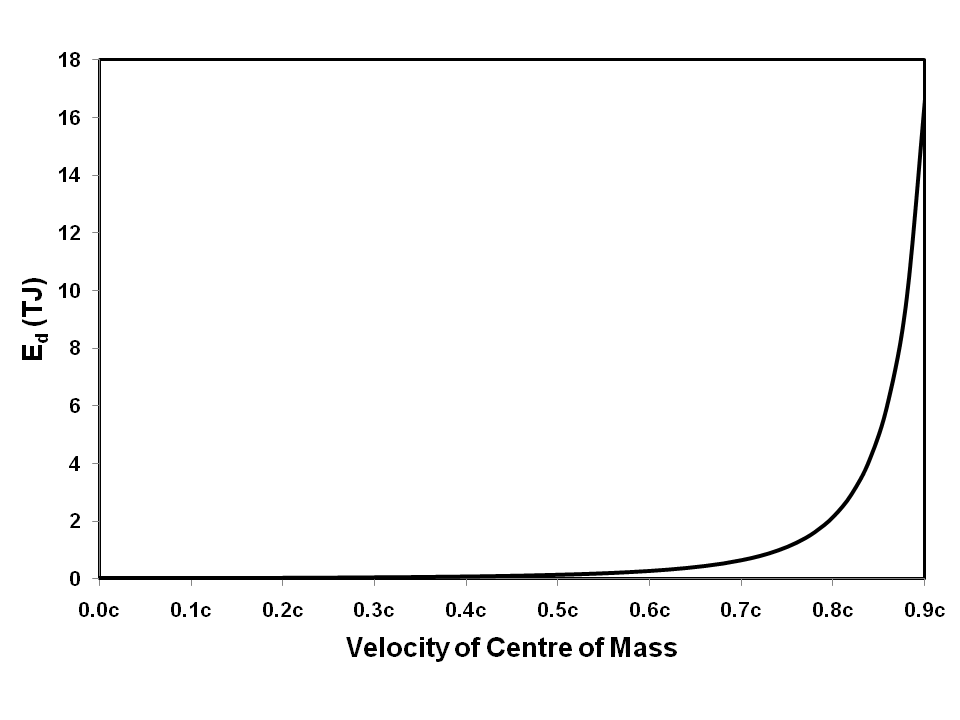
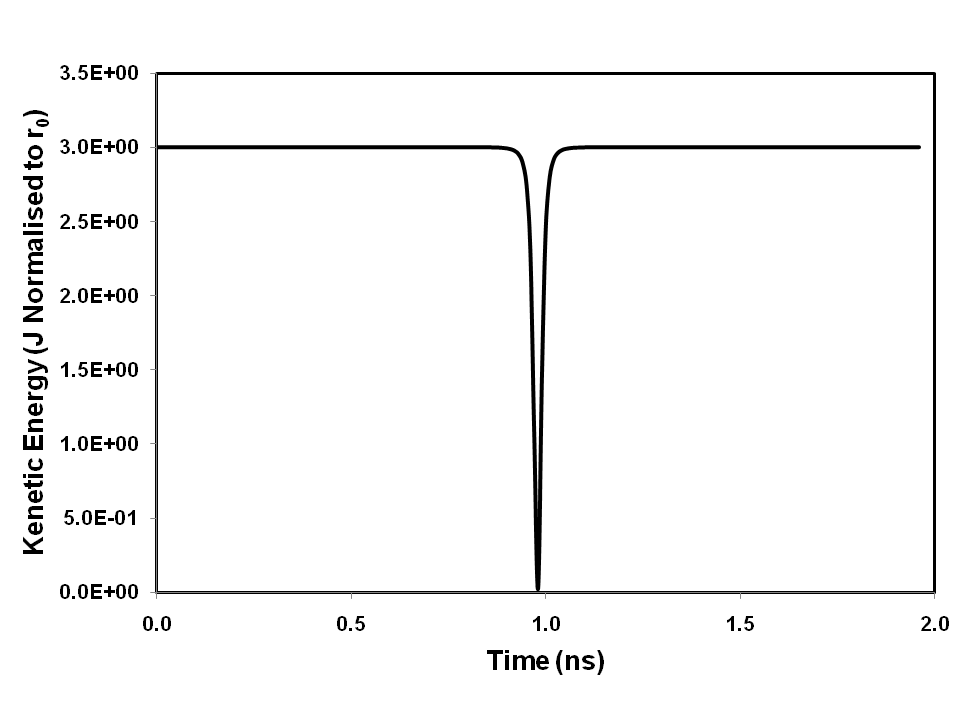
However, there appears to be one drawback to this model. Although energy is conserved by the interaction (that is to say E1 + E2 = E3 + E4 where E1 and E2 are respective initial kinetic energies of particles A and B and E3 and E4 are their respective final kinetic energies) the total kinetic energy does not remain constant throughout the interaction. The total kinetic energy for the interaction plotted in Figure 2 is shown in Figure 3. It turns out that the energy deficiency, Ed, at the point of closest approach is given by:
| |
|
15 |
Figure 3: The energy deficiency of a constant momentum elastic collision
Ed is constant for all relative shifts in velocity. That is to say, for any pair of given masses, mA and mB, Ed will remain the same for any given difference between the initial velocities, vA and vB. In fact Ed is the total incident energy when the particles are observed from the frame of reference of the centre of mass. The centre of mass reference frame may be calculated by setting the initial velocities vA' and vB' such that:
| |
|
16 |
| But |
|
17 |
| So |
|
18 |
| And |
|
19 |
| Giving |
|
20a |
| Similarly |
|
20b |
From this frame of reference it is elementary to determine the total kinetic energy via the equation:
| |
|
21 |
6 Constant Energy Calculations
The concept of constant energy calculations was investigated using the formula:
| |
|
22 |
Where dE/dt is the rate of energy transport with respect to time and f (x) is some function of x, the separation between the particles. If E = 1/2.mv2 then dE/dv = mv and, by the chain rule, dE/dt = dE/dv.dv/dt, so
| |
|
23 |
| Hence |
|
24 |
This approach leads to several serious difficulties. For an interaction where both particles have velocities of the same sign and the signs of the velocities remains unchanged throughout the interaction, momentum is only conserved when a delay factor is introduced to moderate the rate of energy change in proportion to the difference between the particle velocities. If the particles have velocities of opposite signs, it is necessary to introduce a directional property to energy to maintain energy conservation. Finally, if the velocity of one or both particles reverses, it is impossible to maintain conservation of energy. Hence it is hypothesised that the constant energy mechanism cannot be an acceptable representation of an elastic collision.
7 Implications for Momentum
The concept of momentum transfer by photon transport fits very well with the concept of the de Broglie vector. From E = 1/2.I pc2 (from Section 3 above) and the Einstein relationship E = hf, we can easily derive the equivalent of Howe's Equation 3 [1]:
| |
|
25 |
If we hypothesise that the de Broglie vector rotates in a plane normal to the direction of momentum transfer, the direction of rotation will determine the direction of momentum transfer, the amplitude of the vector is equivalent to Ip, the inertia of the photon, while the rotational velocity is determined by the product of Ip and c, the linear velocity of the photon. Thus the de Broglie vector completely describes the momentum transfer process (and hence the energy transfer).
One of the consequences of assuming momentum transfer, as opposed to energy transfer, is that the process can be considered as bi-directional. That is to say, Particle A transferring positive momentum to Particle B is equivalent to Particle B transferring negative momentum to Particle A. This means that the concept of Galilean relativity is maintained.
A key advantage of considering that momentum (rather than raw energy) is transferred by photon transport is that we can now abandon the idea of the notional velocity introduced in Section 4. That is to say, if two stationary particles transfer momentum by photon transport, they will move off in opposite directions.
The energy deficiency curve of Figure 3 can be explained by assuming that the deficiency in kinetic energy is stored as some form of potential energy, such as strain energy. The precise nature of the energy deficiency in an elastic collision is a matter for further investigation. However, in an inelastic interaction, normal energy loss processes, such as heat production, may account for the energy deficiency. Howe [7] has proposed a model for thermal energy transmission by photon transport. The following section further develops the theme of energy loss using the energy deficiency concept developed in Section 5.
8 Energy Change and the Reference Frame
Howe [1] has drawn attention to the fact that when a body accelerates or decelerates, the energy change will be observed to be different by observers in different frames of reference. The above discussion provides a means for resolving this conflict. It is simplest to begin from the frame of reference of the centre of mass of the two particles. At the instant when the two particles are at rest, the Energy deficiency will be equal to the initial total kinetic energy of the two particles. From Equations 20 and 21 we can see that
| |
|
26 |
| Giving |
|
27 |
If we now change the notation slightly so that m1 = mA, m2 = mB, v1 = vA and v2 = vB - vA, we can rewrite Equation 27 as
| |
|
28 |
| From which we get |
|
|
29 |
This demonstrates conclusively that Ed depends only on m1, m2 and the differential initial velocity, v2 and is independent of the absolute velocities of the two particles, as proposed in Section 5. However, the implications are much more general than this. Consider any closed system of two bodies moving relative to one another, where the momentum remains constant within the system as a whole. If the bodies change velocity, so that the two velocities become identical, the energy change, Ed, will be constant for all observers in every frame of reference. To see how this works, consider a two cyclists of identical mass, one riding along at velocity v2 on a moving train travelling with velocity v1, while the other rides alongside the train at velocity v1 + v2. The two cyclists will be travelling at the same velocity when observed either from a stationary reference frame or from the reference frame of the train. Now consider that the two cyclists apply their brakes so that the one on the train comes to rest on the train and the other is travelling at the same velocity as the train. The momentum lost by the cyclist on the train will be transferred to the train, whilst the momentum lost by the cyclist alongside the train will be transferred to the Earth. If we apply Equation 29 to the train and the cyclist on the train, we see that two observers, one on the train and one beside the track, will both agree about the energy lost in braking. The observer beside the track will also observe that the energy loss will be greater for the cyclist beside the train. We now demonstrate that both observers will agree about the energy loss of the cyclist beside the train. Starting from first principles we can write the initial momentum of the cyclist and the Earth in general terms as, Pi where
| |
|
30 |
And the final momentum, Pf, as
| |
|
31 |
In these two equations v0 and (v0 + v5) are the respective initial velocities of m0 and m3, and (v0 + v3) and (v0 + v4) are the respective final velocities of m0 and m3. By equating Pi and Pf we get
| Resulting in |
|
|
35 |
We can now use this expression in the equations for initial and final energies (respectively Ei and Ef):
From Equations 35, 36 and 38 we get
Once again, the energy loss, Ed, is fully described by the differential velocities, without reference to the absolute velocities of either m0 or m3. Hence, all observers will agree on the energy loss associated with such velocity changes. In the case of our example, m0 represents the Earth and m3 the cyclist beside the train. So the observer on the train will agree with the observer beside the track about the energy loss of the cyclist beside the train. Because m3 is small compared with m0 and m2 is small compared with m1, we can write the Energies dissipated as:
| Cyclist on train |
|
|
| Cyclist beside the train |
|
|
If we recall that v5 is equal to v1 + v2, v4 is equal to v1 and m3 is equal to m2, Ed for the cyclist beside the train reduces to
It is now clear that the energy dissipated by a change in velocity depends on the system within which momentum is conserved, not the frame of reference of the observer.
9 Conclusions
By assuming that photons have inertia and that this can be transported to other particles, it is possible to account for the phenomenon of special relativity by quantum mechanical arguments. We have shown that an adaptation of the revised relativity equation [4] can be used to describe relativistic behaviour in a two-particle universe. Calculations have been used to demonstrate that, if photon transport is the means of transferring kinetic energy in an elastic collision, it must obey a constant momentum relationship, rather than a constant energy relationship. In a constant momentum driven kinetic energy transfer, there will be a transient energy deficiency, with the energy stored as some form of potential energy during the interaction. The idea of constant momentum transfer agrees with the Galilean concept of relativity. By referring to the momentum of a complete system, rather than that of an individual component, it is possible to demonstrate that all observers will agree about energy dissipated. The equations for energy deficiency developed for elastic collisions prove to be an ideal means of demonstrating this. The principle of momentum transfer by photon transport agrees with special relativity, quantum mechanical principles and Newtonian mechanics.
References
[1] L D Howe, A quantum approach to relativity,
www.innovationgame.com/physics (2000).
[2] L D Howe, A Possible Mechanism for Wavelike Observations of Quantum Particles,
www.innovationgame.com/physics (2001).
[3] L D Howe, Refraction of Quantum Particles Without Waves,
www.innovationgame.com/physics (2001).
[4] L D Howe, Revised Relativity,
www.innovationgame.com/physics (2001).
[5] L D Howe, Symmetry Between Gravitational and Electric Forces,
www.innovationgame.com/physics (2001).
[6] W Kuijk-Grünbauer, General solution of the complex time-dependent wave equations for particle and antiparticle,
www.innovationgame.com/physics (2002).
[7] L D Howe, Thermal Conduction by Photon Transport,
www.innovationgame.com/physics (2001).
[8] W Kuijk-Grünbauer, A re-dimensionalization of Physics conducive to unified fields, reformulations in QED, Relativity and Strong Forces,
Under development (2003).
www.innovationgame.com/physics/photen.htm January 2003